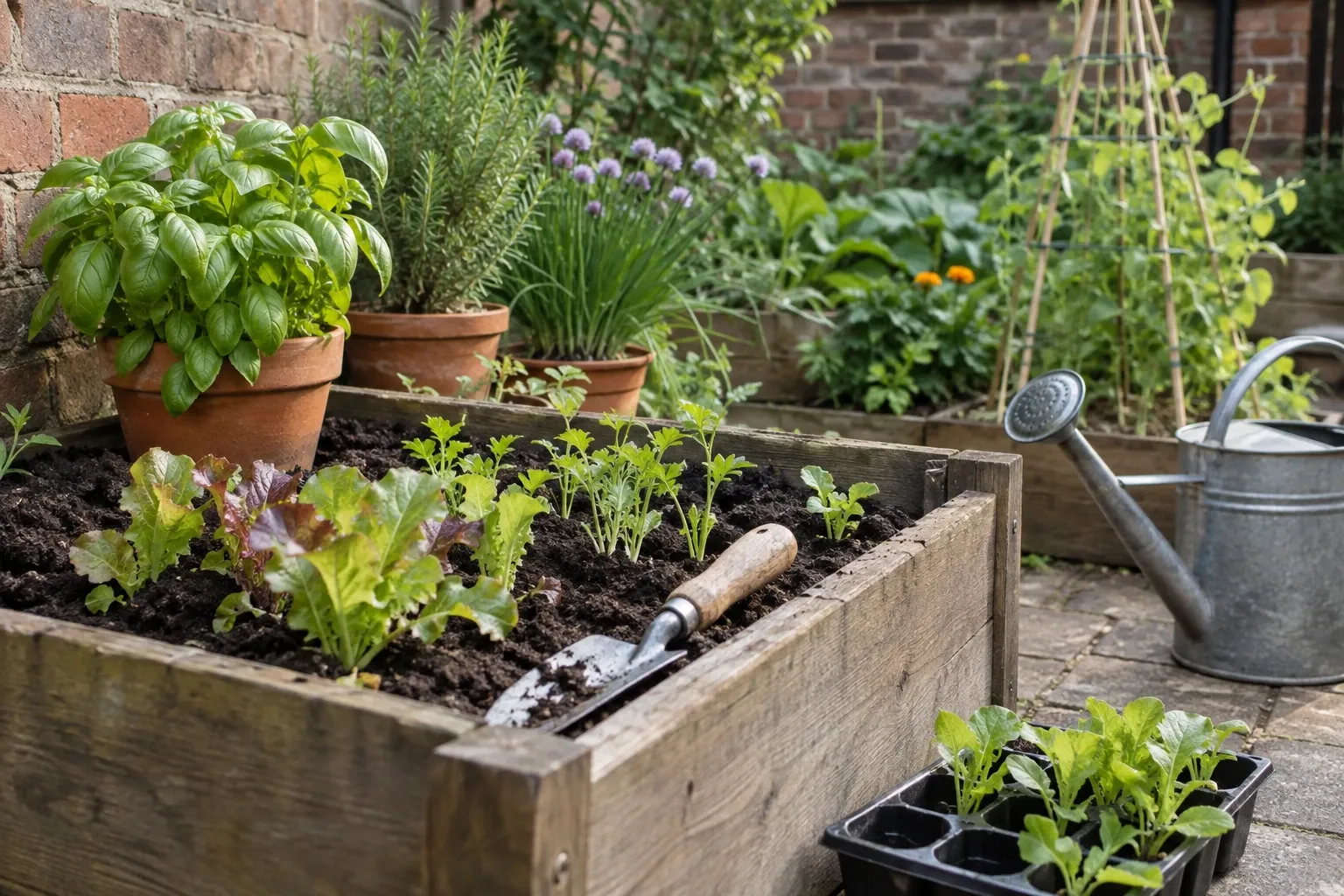
You don’t need a big plot or a shed full of kit to start gardening. What you do need is a small, workable plan that fits your space, sun and free time, so you can keep going after the first weekend. This page walks you through reading your garden, choosing the simplest tools, improving soil, picking reliable plants and building easy routines for watering, feeding and pruning that work with UK seasons.
Start with what you want the space to do this year
Decide your main job for the next six months: a low‑care border you can enjoy from the kitchen, a couple of pots for herbs, or two raised beds for salads and a few summer veg. Be honest about free time and access to water. Sketch the plot with doors, paths, taps and the sun’s path; that drawing will help you position containers, beds and seats.
How to read your sun, soil and microclimate
- Sun and wind: Watch where sun falls at midday and late afternoon on a clear day, and note wind tunnels between buildings. Shaded, windy corners dry out pots; warm brick walls suit tomatoes and figs.
- Soil texture and pH: A quick squeeze test shows texture (sticky clay, crumbly loam, gritty sand). For pH, use a simple test kit; it guides plant choice and feeding. The Royal Horticultural Society explains how to test and why pH matters for nutrient uptake (RHS soil pH advice).
- Frost risk: Late frosts still strike well into May in parts of the UK, especially inland, northern and high‑ground sites, so keep fleece or cloches ready for tender plants and blossom. The Met Office notes that late‑spring frosts remain possible and vary regionally (Met Office on late spring frost).
If you garden on heavy ground, tackle structure gently and avoid digging when wet. Learn how to work with clay soil so you improve drainage and rooting without making compaction worse.
Pots, raised beds or ground: which fits a small UK plot?
- Containers: Best for patios and renters; choose 30–45 cm‑wide pots for herbs and compact veg. Use quality peat‑free potting compost and raise pots on feet for winter drainage. See how to choose peat‑free compost for the plants you grow.
- Raised beds: Great on poor or compacted ground. Two beds at 1.2 m wide let you reach the centre from both sides; keep paths 40–60 cm wide for a barrow. Fill with a mix of topsoil and peat‑free compost.
- In‑ground beds: Cheapest and good for perennials and shrubs. Add organic matter annually and mulch to reduce weeding.
The simplest toolkit that gets real work done
You can achieve most beginner jobs with pruners, a hand trowel, a hand fork, a digging spade, a border fork, a rake, a watering can with rose and a stiff brush for paths. Build yours sensibly with our pick of essentials in a useful gardening toolkit.
What to plant first — reliable starters for UK conditions
- Containers: Salad leaves, cut‑and‑come‑again lettuces, chives, parsley, mint (in its own pot), bush tomatoes on a sunny wall, dwarf French beans after frost risk.
- Beds: Spring bulbs for autumn planting, hardy perennials like geraniums and astrantia, and a couple of compact shrubs for structure.
- Climbers and roses: Choose one rose for scent and a climber for height. When they’ve settled, use our guide to prune your roses at the right time.
Watering and feeding without wasting effort
Water deeply and less often so roots grow down. In veg beds, prioritise watering at key stages rather than every day. The RHS advises focusing scarce water on crops like peas and beans in flower, potatoes as they tuberise, and leafy veg before wilting, rather than spreading it thinly (RHS vegetable watering). In heat, water early morning; in cool spells, check with a finger a few centimetres down before you lift the can.
Feed little and often in containers with a balanced liquid feed once plants are in steady growth. In beds, favour mulch and compost over frequent fertiliser — it improves structure and moisture‑holding so you water less.
Improve soil with compost you can make yourself
Home compost turns prunings, leaves and veg peelings into a soil improver that cuts waste and feeds the soil. As a rule of thumb, balance “greens” (moist, nitrogen‑rich) with “browns” (dry, carbon‑rich) by volume to keep the heap aerated and sweet; Garden Organic outlines what counts in each group and how to keep a good mix (Garden Organic: what to compost). When you have enough material, see how to turn garden waste into compost and use it as a 5–8 cm mulch.
A simple first‑year plan that fits UK seasons
- Early spring: Clear winter debris on a dry day. Top‑dress containers. Sow hardy salads under cover.
- Mid to late spring: Harden off tender plants once frost risk eases locally; plant out after a mild spell. Stake perennials while small.
- Summer: Water and feed containers, deadhead weekly, and thin congested veg rows. Harvest little and often.
- Autumn: Plant spring bulbs and bare‑root shrubs, mulch beds, and start a leafmould pile.
- Winter: Prune deciduous shrubs in dormancy where appropriate, protect pots from waterlogging, and plan next year.
How to tell it’s working — and what to tweak
- Plants put on steady growth, leaves hold good colour, and pots don’t wilt between waterings.
- Soil under mulch stays moist after a dry week, and weeds are fewer and easier to pull.
- You’re spending short, regular sessions rather than firefighting.
If growth is poor despite watering, revisit pH and drainage; the RHS explains simple home testing and what the results mean. If tender plants are checked in May, assume frost: protect for a few nights next time; late snaps are a known UK risk.