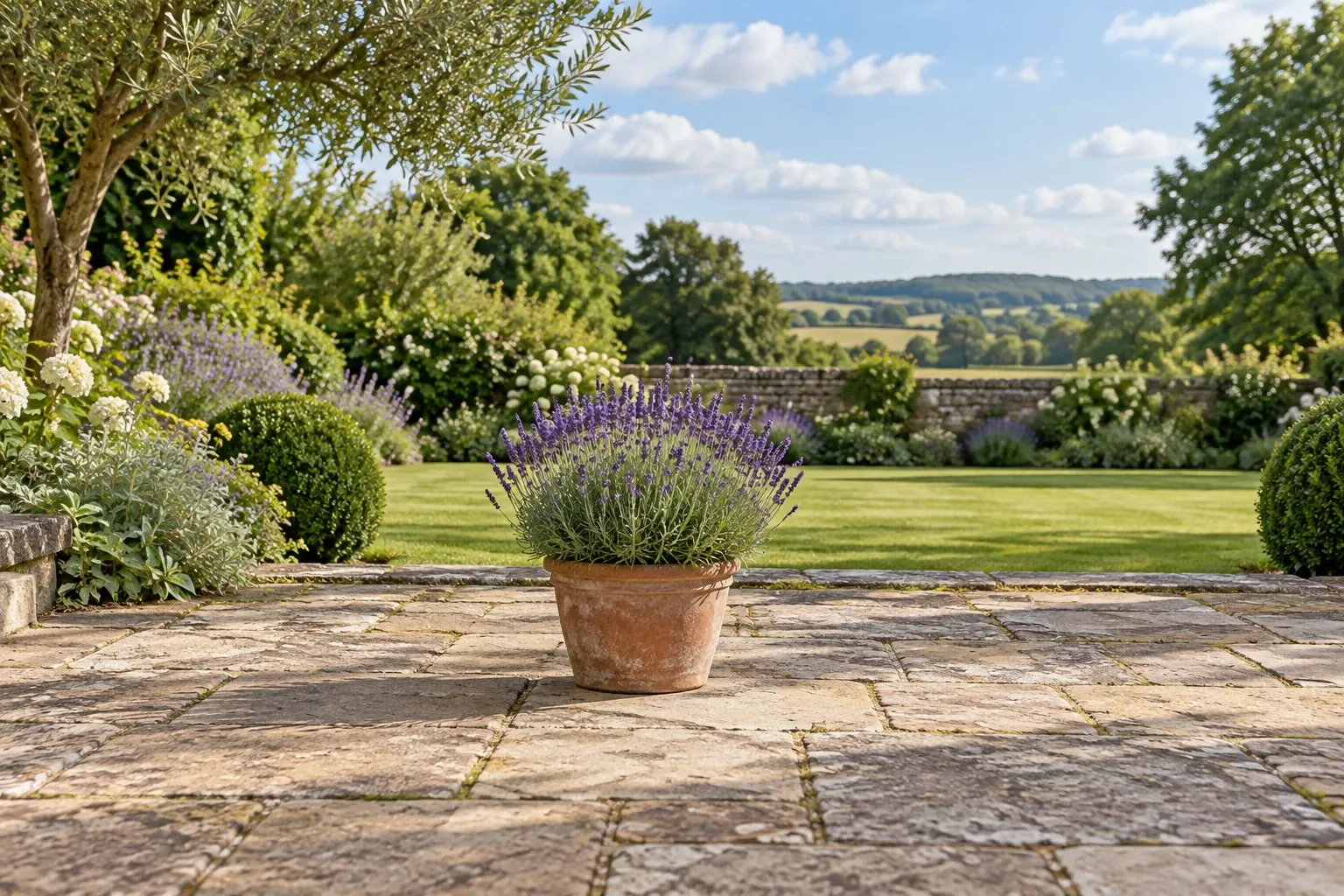
Lavender may look at home in a sunny border, but clay that remains wet after rain creates a difficult setting for its roots, particularly in a cold, wet UK winter. The key question is not simply whether your soil is clay, but whether water drains away from the planting spot. You can assess that before buying a plant, then choose between a raised planting position and a container rather than relying on a small addition of grit to change heavy ground.
What makes clay soil difficult for lavender?
Clay is not automatically a problem for every plant, but heavy clay can drain slowly and stay wet for long periods. Lavender needs a sunny position and free-draining soil; when its roots sit in persistently wet ground, they can suffer root rot. The Royal Horticultural Society (RHS) advises against growing lavender in heavy clay or waterlogged soil, and suggests a raised bed or container where those conditions cannot be avoided, as explained in its lavender growing guide.
This means the answer to “can lavender grow in clay soil?” depends on how wet the root zone becomes, not just the soil’s name. A sunny border on clay that drains adequately is different from a low patch where puddles linger through winter. Lavender also prefers relatively low-nutrient soil, so there is little reason to turn a planting area into a rich, heavily fed bed. If you are new to gardening, begin by checking the site’s light, soil and maintenance needs as part of starting a garden in the UK.
How can you tell whether the planting spot drains well?
Notice what happens after sustained rain. Does water stand at the surface, or does the soil remain saturated for a long time? Is the spot at the bottom of a slope, beside a downpipe, or shaded by a wall or dense planting? Those details help distinguish a site that is merely clay-rich from one where roots are likely to remain too wet. Compare the proposed spot with a higher, sunnier part of the garden if you have one.
The RHS describes clay soils as slow-draining and warns that wet clay is easily damaged by walking or working it. Avoid digging or testing heavily when it is waterlogged; trampling can compact the soil and worsen its structure. A simple soil check is to take a moist sample and try rolling it: clay is smooth and can be shaped into a ball or sausage, while soil with more sand tends to crumble. For more on improving and working this type of ground, see ways to improve clay soil.
A drainage check should help you choose a planting method, not encourage you to dig a deep hole and fill it with a different material. If the site has a high water table or an impermeable layer below the topsoil, changing the surface soil alone may not solve the problem. Where the ground stays wet, move the lavender to a higher position or grow it in a container with open drainage holes.
Which planting option suits your garden?
If the soil is heavy but the spot is otherwise suitable, the RHS recommends planting on a mound, ridge or raised bed so the roots sit above wet ground. Its lavender guidance gives a mound height of 20–30cm. That is a practical starting point, not a guarantee: the mound still needs to shed water, and a position that is persistently waterlogged may call for a different site altogether.
For a border, a raised bed can give you a deeper zone of better-drained growing medium without trying to alter the whole garden. Make sure excess water has somewhere to go rather than creating a closed box that holds it in. Raised beds also dry more quickly than surrounding ground, so check moisture during dry spells. If you are planning a bed for other plants too, lavender’s preference for sun and relatively dry conditions should guide where it sits.
A container is often the most controllable choice for a patio or a small garden. The RHS recommends a container 30–40cm in diameter, with large drainage holes. It suggests peat-free multipurpose or loam-based compost and coarse grit in the compost mix, up to 25 per cent by volume. Those proportions apply to a container growing medium, not to scattering a small quantity of grit into a whole bed of heavy clay. Stand the pot where water can escape and avoid leaving it in a water-filled saucer.
Why won’t a handful of grit fix heavy clay?
It is tempting to mix grit into the planting hole and assume that will make the surrounding soil drain. But the RHS notes that clay particles strongly influence the behaviour of a soil, so diluting them takes a very large volume of grit or similar material. It says this is seldom practical for most gardeners and points instead to options such as raised beds, organic matter and choosing plants suited to clay.
That distinction matters for lavender: a carefully mixed container compost is one thing; a token amount of grit added to heavy ground is another. A hole filled with a different material can also collect water if the surrounding clay prevents it from draining away. Instead, lift the planting position above the wet layer, use a raised bed that can drain, or choose a pot. If the rest of the garden needs soil work, make changes across a useful area and follow clay soil improvement methods rather than treating one small planting hole as a drainage system.
How should you plant and care for lavender?
Choose a sunny position and plant when the soil is workable, not saturated. The RHS recommends April or May for planting, when soil is naturally warming, and advises against winter planting because young plants are vulnerable to rotting in cold, wet soil. Local conditions vary across the UK, so wait if your site is still waterlogged and consider your area’s frost exposure. Select a type described as hardy if it will remain outdoors through winter.
Set the plant at the same depth it was growing in its pot, and avoid burying the stem. For group planting, the RHS suggests spacing plants about 90cm apart; for a lavender hedge it gives 30cm between plants, or 45cm for larger cultivars. These are different layouts for different uses, so leave enough room for the mature plant rather than squeezing a border to look full immediately. Follow the plant label if it gives spacing advice for a particular cultivar.
Water a newly planted lavender regularly during its first summer, especially in dry weather, while avoiding waterlogged soil. Once established in the ground, lavender is drought tolerant and usually needs little watering except during severe drought, according to the RHS. Pots are different: their limited compost can dry out quickly in summer, so check them regularly. In winter, keep container compost relatively dry and shelter the pot from excessive rain where practical.
What should you watch for after planting?
Check the root zone after rain and during the first growing season. Persistent wetness, a pot that cannot drain, or a raised bed with nowhere for excess water to go means the basic drainage problem remains. Do not try to compensate by repeatedly adding grit to the surrounding clay. Adjust the growing position or container setup instead.
Keep watering purposeful: newly planted lavender needs help while it establishes, but established plants do not need frequent watering in ordinary conditions. A container may need more attention than a plant in the ground, especially in warm, dry weather. Also check how the position performs over winter, when cold and wet can combine to put roots under stress. If a site stays saturated, treat that as a sign to relocate the plant or use a better-drained growing space, not as a reason to keep amending a small patch of soil.