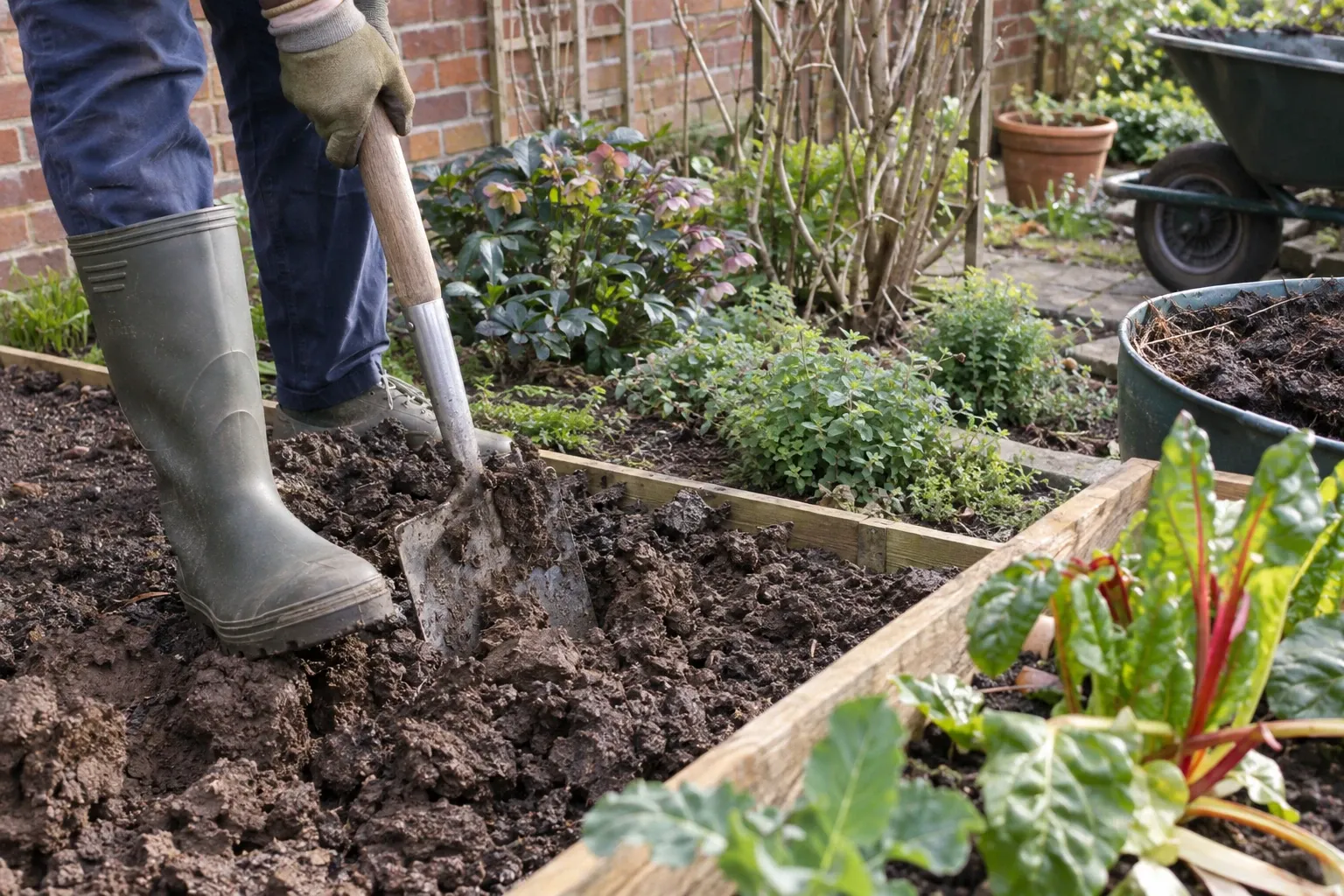
You’ve dug into your border and hit sticky, heavy clay. Water lingers after rain, beds stay cold in spring and footprints seem to last for days. The aim isn’t to “change” clay into something else, but to improve its structure so roots and air can move. Below you’ll learn how to identify clay quickly, what to avoid, and the UK‑proven ways to make it easier to work and more productive, season by season.
How do you know it’s clay?
Clay feels smooth and slightly sticky, rolls easily into a sausage without cracking, and often drains slowly after rain. The Royal Horticultural Society describes these quick field checks and notes that wet clay is easily damaged when walked on. See the identification tips in the RHS clay soils guide.
– If your soil smears to a shine when rubbed, it’s likely a heavy clay.
– Don’t confuse soil structure (how particles clump into crumbs) with drainage: clay can be nutrient‑rich yet still poorly aerated if compacted.
Start a garden you can keep growing if you’re just beginning and want the broader basics alongside this page.
What should you change—and what should you leave alone?
- Do not work or tread clay when it’s wet. The RHS warns that this destroys structure and leads to long‑lasting compaction.
- Avoid the “quick fix” of adding a little sand. The RHS explains that to materially dilute a clay fraction you’d need around 250kg of grit per m²; smaller amounts can actually worsen workability.
- Aim to build stable crumbs with organic matter and roots rather than endlessly double‑digging; repeated heavy cultivation can smear and compact layers.
Which options really help UK clay?
- Bulky organic matter. Well‑rotted compost, manure, leafmould or composted bark improve workability and resilience on clay, according to the RHS advice.
- Green manures (cover crops). Garden Organic reports that green manures protect bare soil, add organic matter and improve structure; they can be cut and left as mulch or incorporated shallowly to feed soil life (Garden Organic; see also their practical note on timing and benefits in schools gardening from the RHS Campaign for School Gardening info sheet).
- Raised beds and mounding. The RHS lists raised beds and slight mounds (about 25cm) as simple ways to keep roots out of winter waterlogging on clay.
- Gypsum or lime, with caution. The RHS notes some clays respond to extra calcium: use lime on acid soils or trial gypsum elsewhere on a small patch first to judge any benefit.
Step‑by‑step: improve a bed this season
- Pick your moment
- Wait until soil is just workable: squeeze a handful—if it forms a shiny smear, wait; if it breaks with a light poke, you can proceed. The RHS stresses avoiding wet conditions to protect structure.
- Create firm access
- Lay boards, stepping stones or paths before you start so you don’t compact the bed. The RHS specifically recommends ample paths on clay to prevent damage from trampling.
- Add bulky organic matter
- Spread 5–8cm of well‑rotted compost, leafmould or composted bark over the surface and incorporate only the top 10–15cm where you’re planting this year. RHS advice highlights composted bark as especially effective for workability on clay.
- Switch to surface mulches
- Around established shrubs, trees and perennials, leave organic mulches on the surface rather than digging them in; worms and roots will do the mixing. This reduces summer cracking and conserves moisture per the RHS.
- Sow a green manure on bare ground
- Between crops or over winter, sow a suitable mix so living roots keep soil open, protect from rain impact and feed it when cut down. Garden Organic sets out how green manures improve structure and fertility and how to handle them in small gardens.
- Raise where drainage lingers
- If water still lies after rain, form 20–30cm high mounds or install simple raised beds filled with a loamy mix; this lifts roots into better‑aerated soil while the underlying clay improves over time. The RHS recommends raised beds for exactly this situation.
- Trial calcium on a test patch (optional)
- On neutral to alkaline clays, trial gypsum on 1–2m² and compare feel and workability after a few months; on acid soils, use garden lime instead. This mirrors the RHS “test small first” guidance.
Tip: If you’re building up kit for this work, see how to build a useful gardening toolkit so you have a sturdy digging fork, board for access and mulching gear.
How will you know it’s working?
- Feel and crumble: soil that once smeared begins to break into small, rounded crumbs when lightly pressed; roots penetrate more evenly.
- Water behaviour: puddles clear more quickly after rain in raised beds and mulched borders, though the subsoil may still drain slowly—that’s normal for clay.
- Seasonal timing: beds dry and warm a little earlier in spring, letting you plant maincrops on schedule. RHS guidance notes that while early sowings are a challenge on clay, maincrops can be excellent once structure improves.
If you’re also tending mature shrubs, timing matters elsewhere too—see how to prune your roses at the right time so you don’t stress plants on heavy ground.
Why this works: the soil science in brief
Adding organic matter and keeping roots in the ground build stable aggregates, which improves both aeration and resilience. UK advisory bodies show the same pattern from field to garden: cover crops and added organic matter increase soil organic matter and improve structure, leading to better water handling and fewer compaction issues (AHDB overview). The RHS complements this with practical thresholds and clear cautions for home gardens.