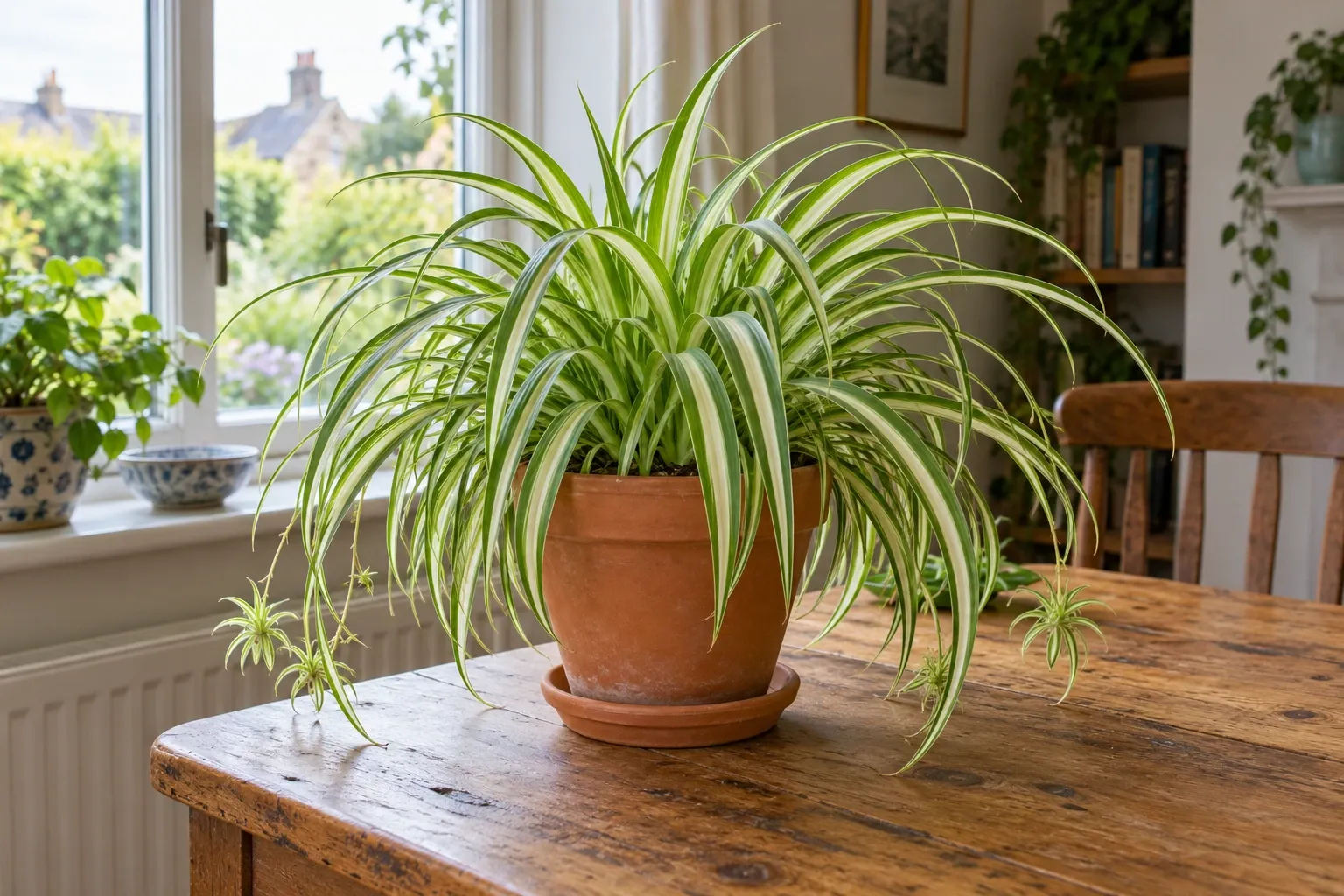
If your spider plant has brown tips, crowded roots or long stems carrying small plantlets, the next step is not necessarily more water or a larger pot. First check its light, warmth and compost, then decide whether it needs a simple trim, a change of position or repotting. The plant’s tolerance makes it forgiving, but UK temperatures and winter light still affect how you care for it.
Where should you place a spider plant?
Choose a bright position with indirect or dappled light. A little distance from a sunny window can help prevent strong summer sun scorching the leaves, while a very dim corner may leave the plant looking less vigorous. The Royal Horticultural Society (RHS) says spider plants tolerate low indoor light but prefer a bright position out of direct sunlight. Rotate the pot occasionally if one side is growing towards the window.
Spider plants are usually grown in the UK as indoor foliage plants, not as permanent residents of a garden border. The RHS lists the species’ height and spread as 0.1–0.5 metres, so allow for a spreading clump as well as the longer stems that carry flowers and offsets. A shelf or hanging basket shows off those stems, but make sure the pot is stable and the leaves are not pressed against a hot radiator or cold, draughty window.
If you are choosing plants for an outdoor bed rather than a room, match your choice to the garden’s conditions and the time you can give it. You can use the same practical checks when starting a garden in the UK. A spider plant is a poor choice for a spot that may freeze: the RHS gives it an H2 hardiness rating, which describes tolerance of low temperatures but not freezing, and advises growing it in a frost-free environment.
How much light and warmth does it need?
Keep the plant away from intense direct sun, especially through glass in summer. If the leaves lose their usual colour or growth becomes sparse, try a brighter position with filtered light. If the leaves show scorched patches, move it out of the direct rays. These changes are more useful than moving the plant repeatedly; give it time in its new spot before judging the result.
Warm, steady indoor conditions are more reliable than a cold conservatory or an exposed patio. In its plant profile, the RHS says to grow spider plants ideally above 10°C. Its H2 rating is described as a minimum range of 1–5°C, but that does not mean the plant should be kept at those temperatures; the RHS cultivation advice is to provide frost-free conditions. In practice, bring a plant indoors before cold weather rather than relying on a mild forecast or a sheltered wall.
When should you water a spider plant?
Check the compost rather than watering to a fixed weekly schedule. Water when the surface has started to dry, then let excess water drain freely from the pot. Do not leave the container standing in a full saucer: persistently soggy compost can damage roots. A pot with drainage holes makes it easier to judge and manage moisture.
The compost will dry at different rates depending on room temperature, light, pot size and season. It may need checking more often during warm, bright weather and less often when growth slows in winter. Avoid both extremes: repeatedly adding small splashes can leave some roots dry while the pot stays wet in other places, and watering again before the compost has begun to dry can keep the roots too damp.
The North Carolina Extension Gardener Plant Toolbox describes Chlorophytum comosum as tolerant of some drought, but that should not be taken as a reason to leave it dry for long periods. It also advises reducing watering during winter. Use the plant’s condition and the compost as your checks, not a rigid calendar. If the pot feels unusually heavy and the compost is wet, wait and check again rather than adding more water.
Which spider plant should you choose?
The familiar variegated spider plant has green leaves striped with white. The RHS identifies ‘Variegatum’ as a traditional, widely available choice, while ‘Vittatum’ has longer arching leaves. ‘Bonnie’ is a compact cultivar with curled foliage; ‘Ocean’ has a green centre and pale margins. Cultivar means a named cultivated selection with distinctive features. Choose by the leaf shape and the space available, and check the plant label because forms differ in appearance.
If the plant will sit on a narrow shelf, a more compact form may be easier to accommodate than one with long arching leaves and hanging stems. For a larger display, a basket gives offsets room to hang. For a different foliage effect in an outdoor planting scheme, compare the needs of garden plants such as delphiniums in a border, rather than treating an indoor spider plant as a substitute for a hardy perennial.
How do you pot and propagate it?
The RHS recommends repotting or dividing spider plants every 2–3 years, or replacing an older plant with a young plantlet. Repot when roots are crowded or the compost no longer drains well, rather than moving the plant into an oversized container. Use a pot with drainage holes and fresh peat-free, multi-purpose compost suitable for houseplants. After repotting, water enough to settle the compost and let the excess drain away.
The easiest way to make another plant is to root one of the small offsets, often called spider babies, growing on the long stems. The RHS describes spider plants as easy to propagate from these plantlets. If an offset has formed roots, pot it in its own small container; if it has not, you can set it on the surface of moist compost and keep it attached to the parent until it roots. Once it is established, cut the connecting stem. Avoid keeping the compost saturated while roots form.
The Extension Gardener Plant Toolbox notes a more specific flowering and plantlet pattern: stolons and plantlets develop in response to short days, with less than 12 hours of light a day for at least three weeks. This is useful context if a mature plant is not producing offsets, but it is not a promise that every indoor plant will do so on a schedule. Light exposure, plant maturity and growing conditions also matter. Division is another option when a mature clump has several rooted sections.
How can you tell whether your care is working?
Look for steady new leaves, firm foliage and compost that dries gradually between waterings. A few brown tips alone do not prove the plant is failing. Check the position, watering and drainage before making several changes at once. If the pot remains wet, improve drainage or reduce watering; if the compost dries quickly and the leaves look limp, check whether it needs a thorough drink. Trim dead or badly damaged leaves at their base with clean scissors.
A spider plant may produce small white flowers and then offsets on its arching stems. Those offsets can be left in place for a cascading display or rooted to make new plants. If you do not want more plantlets, the RHS advises trimming finished flower spikes. Check periodically for scale insects, which the RHS lists as a possible pest, and inspect the undersides of leaves when growth looks unhealthy. Adjust one care factor at a time so you can see whether the change helps.