When leaves gather on the lawn and a new bed needs levelling, it is tempting to reach for whichever rake is nearest. The wrong head can make a simple job awkward: rigid metal tines catch in grass, while flexible leaf-rake tines are not made to break up soil clods. Choose by the task first, then consider head width, handle length and how easily you can control the tool in your garden.
Which garden rake suits the job?
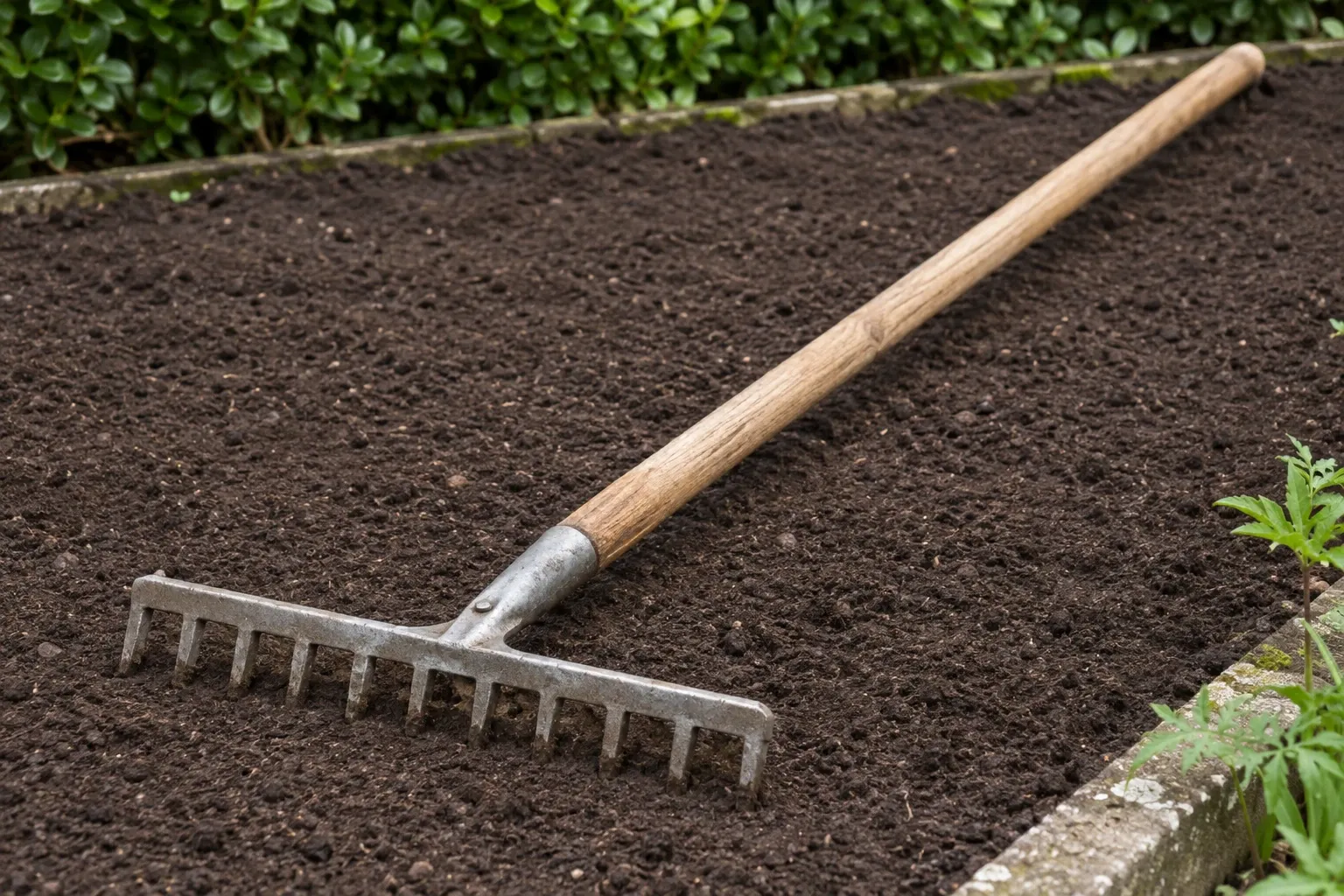
A garden rake usually means a soil rake: a solid, straight head with short, rigid metal tines. Use it to level cultivated ground, break smaller clods, draw soil across a bed and gather stones or roots from the surface. It can also help spread compost before planting. The straight head gives you more control over soil than a fan-shaped leaf rake, but its hard tines can snag turf and plant stems.
A leaf rake, also called a lawn or spring-tine rake, has a wider fan of longer, flexible tines. It sweeps leaves, grass clippings and light debris from lawns and paths. Plastic heads tend to glide over the lawn surface; springy metal tines can reach further into grass and are also used to pull out moss and thatch. The distinction matters: Thrive notes that steel soil rakes are not suitable for collecting leaves from lawns, and recommends a lighter spring-tine rake for lawn thatch because a steel rake may damage the grass.
For most small gardens, you do not need a collection of specialised heads. Thrive says many gardeners can manage with two types: one to level soil and one to clear leaves. If storage is tight or you garden mainly in containers, a short-handled hand rake can help with small areas, but it does not replace a full-width rake when preparing a bed or clearing a lawn.
What should you check before choosing?
Start with the surface and material you will move most often. Rigid, short tines suit cultivated soil; flexible fan tines suit loose leaves and clippings. If you want a leaf rake that adapts to different spaces, GARDENA lists one model with an adjustable working width of 30 to 50 cm. Its fixed-width leaf rake is 43 cm wide. Those are examples from one range, not standard sizes: compare the head against your lawn, paths and storage space rather than assuming a particular width will suit every garden.
A broad head can cover an open lawn quickly, but it may be awkward between closely planted borders, raised beds or pots. A narrower head is easier to steer into corners and along edges, though it takes more passes across open ground. If your garden combines a small lawn with narrow beds, a medium-width leaf rake and a separate soil rake are often more practical than trying to make one head do both jobs.
Check the handle as well as the head. You should be able to hold it without hunching or reaching uncomfortably, and the rake should feel manageable when you lift and turn it. A lighter model can be easier to use for repeated passes; a broad or heavy head may become tiring, especially when leaves are wet or clumped. For a raised bed or a container, a hand rake keeps the working area close and precise. If bending or grip is difficult, look for a handle length and weight you can manage comfortably, and work in short bursts rather than forcing a long session.
How do soil and leaf rakes compare in use?
A soil rake has a relatively narrow, straight head and firm tines. Draw it across loosened soil to knock down high spots, fill shallow hollows and collect larger surface debris. Turn it over to use the back of the head to press down a seedbed lightly, if the design allows. Do not expect a rake to replace digging or a fork where soil is compacted: it is a finishing and surface-preparation tool, not a way to loosen ground deeply.
A leaf rake has a broader, fan-shaped head and flexible tines. Pull it in gentle, overlapping strokes to gather leaves into manageable rows or piles. On a lawn, use only enough pressure to move the material; digging the tines into the turf can tear grass. In a border, sweep around plants rather than through them. Rubber-tined versions can be a gentler option around new growth, while a hand rake can help where a full-size head cannot pass without catching stems.
A spring-tine rake can also be used to remove thatch, the layer of dead grass and other material that builds up near the base of the lawn. This is a different, more forceful job from collecting autumn leaves. Thrive says a thorough rake for dead grass and thatch may be worthwhile every couple of years, and advises using a lighter spring-tine rake rather than a steel soil rake. The condition of your lawn matters, so do not treat that interval as a requirement for every garden.
How can you use a rake when preparing a bed?
If the ground is already workable, begin by removing large weeds, stones and loose debris. Use the soil rake to level the surface rather than repeatedly turning over ground that does not need it. The RHS advises that uncompacted soil need not be dug over when preparing a border. Once the surface is ready, rake out remaining stones and roots, then draw soil from mounds into hollows until the bed is reasonably even.
If you are adding organic matter, do that before the final levelling. The RHS recommends a layer at least 5 cm deep, aiming for 10 cm on sandy or heavy clay soil, then turning it in with a fork. Use the rake afterwards to remove surface debris and level the planting area; it is not a substitute for mixing that material through the soil. For a new border, the RHS also suggests laying plants out in their pots before planting so you can adjust their positions. That is useful when planning spacing for taller plants such as delphiniums in a border.
When sowing, a level, fine surface helps you place seed evenly. Work backwards from the far side of the bed so you do not tread on the ground you have just levelled. Use short, controlled strokes; if a stubborn clod will not break, Thrive suggests chopping it a few times with the rake head rather than dragging the tool through the whole bed with extra force. For more on assessing soil and keeping up with routine garden care, see how to start and care for a UK garden.
How can you clear leaves without damaging plants?
Choose a dry, calm spell if practical: wet leaves tend to stick together and take more effort to move. Begin at the edge of the lawn and draw leaves into small piles, rather than trying to push a large mass in one pass. Keep the tines shallow and lift the collected material into a bucket, garden-waste container or compost area. If the rake repeatedly catches the grass, lighten your pressure or use a less aggressive head.
Use a narrower sweep around borders, paths and raised beds. A leaf rake can gather leaves from a lawn, but its flexible tines may also pass over small, embedded debris; a spring-tine metal rake can pick up more material from the grass but needs a gentler hand. Near young plants, make short passes away from stems. If the tines are catching leaves and foliage together, stop and clear the blockage rather than pulling harder. Where a rake cannot reach safely, remove a few leaves by hand.
You can make use of the leaves instead of treating them all as waste. The Centre for Wildlife Gardening guide published by Groundwork and The Conservation Volunteers says leaf mould can be used as mulch and, after 18 months of rotting and sieving, as a seed-compost medium. Its suggested simple bin uses four posts and chicken wire. These are practical examples, not mandatory dimensions or a promise that every batch will be ready on an exact timetable; conditions and the material collected affect how it breaks down.
How can you check the result and work comfortably?
After levelling soil, look across the bed from more than one direction. The surface should not have obvious mounds or hollows, and large stones, roots and debris should be cleared from the area where you plan to sow or plant. A rake does not need to leave powder-fine soil: stop when the surface is even enough for the task, rather than repeatedly working it and making unnecessary dust.
After clearing leaves, check lawn edges, around shrubs and between pots for missed material. A few leaves in a border are not the same as a thick layer covering the grass. Use the rake to move what you can reach without dragging it through plants, and leave the head clear of stems when you finish. If you spot soil being pulled up with leaves, change to a lighter touch or a less rigid rake.
Raking involves repeated movement. Thrive recommends a gentle, consistent action and working in very short bursts if you want to reduce hand strain. Keep both hands on the handle, take small strokes and shift your stance instead of twisting your back to reach a distant patch. The Centre for Wildlife Gardening guide also advises switching sides regularly and not leaving a rake on the ground with its prongs pointing upwards. Check the head, tines and handle before use; if anything is loose or damaged, put the rake aside until it is safe to use.
The simplest choice is to match the tool to the material: a rigid soil rake for cultivated ground, a flexible fan rake for leaves and light debris, and a small hand rake for tight planting spaces. Choose a width and handle you can steer without straining, and let the surface tell you when the job is finished.