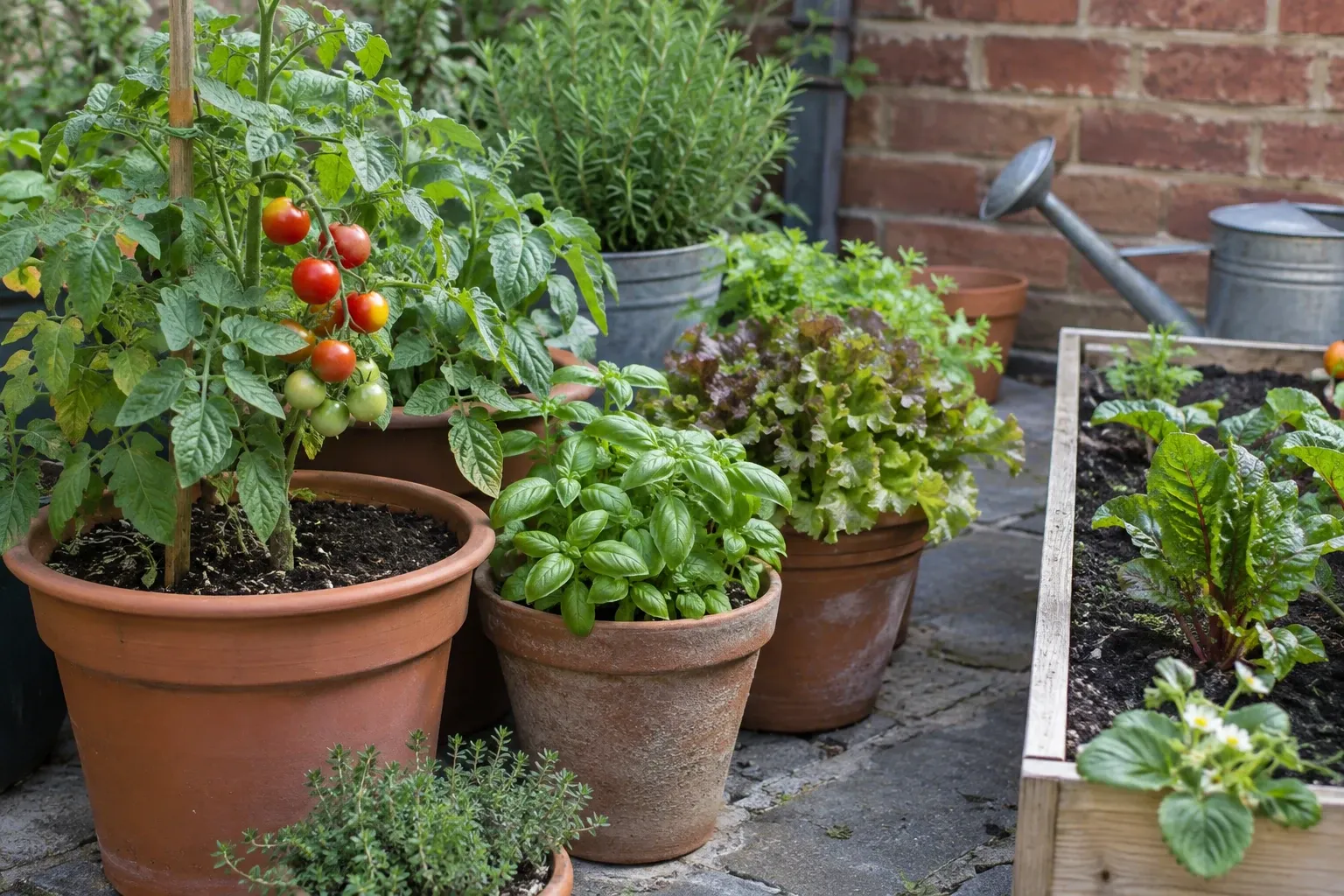
You don’t need borders or an allotment to grow useful food. Pots, troughs and growbags can carry a surprising variety of vegetables if you size them sensibly and keep moisture and nutrients steady. This guide helps you choose realistic crops for UK patios and balconies, match them to containers, and care for them through the season using peat‑free compost, simple supports and regular watering. Where space allows, it also shows when a raised bed or no‑dig patch might be the better next step.
What will grow well in your light, wind and time?
- Sun: Most veg prefer a sunny, sheltered spot; tomatoes in particular need a sunny place, even if that’s just a single pot or a growing bag on a warm wall, as noted by the UK’s gardening charity, the RHS.
- Wind: Tall crops (climbing beans, tomatoes) need a stable, heavy pot so supports don’t act like a sail; the RHS adds that runner beans can thrive in containers if you give them a generous, deep one and firm support (RHS feature).
- Time for watering: Containers dry quickly. Consumer group Which? has shown that even experienced gardeners misjudge moisture in pots and benefit from checking the compost and adjusting frequency, rather than fixed schedules (Which?).
If you’d like to plan a ground‑level plot instead, start with our page on a first UK veg garden: make room for a productive vegetable patch.
The key choices that make containers work
- Container size and shape: The larger the container, the easier it is to keep moisture even; the RHS recommends at least a 30–45 cm diameter pot for one tomato, or two plants per standard growing bag (RHS tomato guide). For climbing or runner beans, aim for a deep, generous pot so the support is stable; 30‑litre class containers are singled out as ideal in RHS advice.
- Compost: Use peat‑free multipurpose or soil‑based mixes. The RHS explains why peat‑free matters and how widely available mixes now combine ingredients like coir, composted bark and loam (RHS containers advice; RHS peat‑free advice).
- Watering: Water thoroughly so the whole root zone is moist, then allow the top to dry slightly before watering again. Adjust to weather and pot size; Which? highlights how easy it is to under‑ or over‑water, so check by hand rather than by calendar.
- Feeding: Most crops in pots need feeding once they’re in active growth. Tomatoes should be fed regularly once fruits start to form, using a proprietary tomato fertiliser as directed.
- Supports: Build wigwams or single canes into the pot at planting so you don’t damage roots later; this is essential for climbing and runner beans (see the RHS runner bean feature).
Which vegetables suit pots, and what size do they need?
Below are UK‑friendly options that crop reliably in containers. Sizes are minimums that keep watering manageable; go larger if you can.
| Crop (UK type) | Pot or trough, minimum helpful size | Notes that matter |
|---|---|---|
| Cherry tomato (bushy type) | One plant in a 30–45 cm diameter pot; or two per standard growing bag | Needs sun and shelter; start feeding when fruits set (RHS tomato guide; RHS edible container idea). |
| Dwarf French beans | A broad, stable pot; larger volumes keep moisture steadier | Easy starter crop for containers; choose dwarf types to avoid top‑heavy pots (RHS French beans; RHS containers advice). |
| Runner or climbing beans | Deep, generous pot around the 30‑litre class, with a cane wigwam | Very productive if watered and fed; stabilise supports in the container. |
| Cut‑and‑come‑again salad leaves | Wide trough or window box for even moisture | Suits shallow troughs; sow repeat little-and-often for a steady bowl of leaves (RHS salad in containers). |
| Courgette (compact variety) | A large container; go big for easier watering | Thirsty and hungry in pots; varieties for containers are noted in RHS school resources (RHS School Gardening). |
| New potatoes (earlies) | Large, deep container or potato bag with good drainage | Early varieties are well‑suited; plant later in colder regions of the UK, as noted by the RHS schools programme (RHS potatoes in containers). |
If you later want lower‑maintenance volume for staples, read about setting up raised beds or starting a no‑dig bed.
How to plant your patio veg, step by step
- Match pot and place
- Choose a stable pot with drainage. Put tall crops where wind is gentlest and sun is longest.
- Fill with peat‑free compost
- Fill with a quality peat‑free mix; modern blends use coir, composted bark and loam and are widely available in the UK (RHS containers advice; RHS peat‑free advice).
- Plant at the right time
- Tomatoes and beans go out after frost risk has passed in your region; potatoes in containers are commonly started in spring, with timing a little later in colder areas.
- Water deeply and regularly
- Water until it runs from the holes, then check moisture before the next soak. Expect to water daily in hot, dry spells; Which? shows moisture checks beat fixed routines.
- Feed as crops demand
- Start tomato feed once fruits set; for other crops, use a balanced liquid feed as growth takes off, following label directions.
How do you know it’s working?
- Growth and colour: New leaves should be a healthy green; pale leaves or slow growth often mean hunger in containers, so review feeding.
- Moisture: Wilting at midday sun can be normal, but leaves that stay limp into the evening point to dry compost; increase watering depth and frequency (see the moisture pitfalls highlighted by Which?).
- Harvest cues: Pick salad leaves young and often; harvest courgettes when they are roughly 10–12.5 cm long for best flavour and texture, according to RHS schools guidance (RHS courgette crop sheet); pick runner and French beans when pods are tender; lift container potatoes once foliage yellows or early as “new” when plants flower (timings and methods in RHS potatoes in containers).
Troubleshooting common container problems
- Pots drying within hours: Up‑size containers where you can and mulch the surface; the RHS repeatedly notes that larger volumes buffer moisture better for crops like tomatoes.
- Top‑heavy supports: Choose deep, heavy pots for climbers and build the wigwam at planting (good practice highlighted in the RHS runner bean feature).
- Compost choice doubts: Stick to peat‑free; the RHS sets out why, and today’s mixes perform well in containers when watered and fed appropriately (RHS peat‑free advice; RHS containers advice).