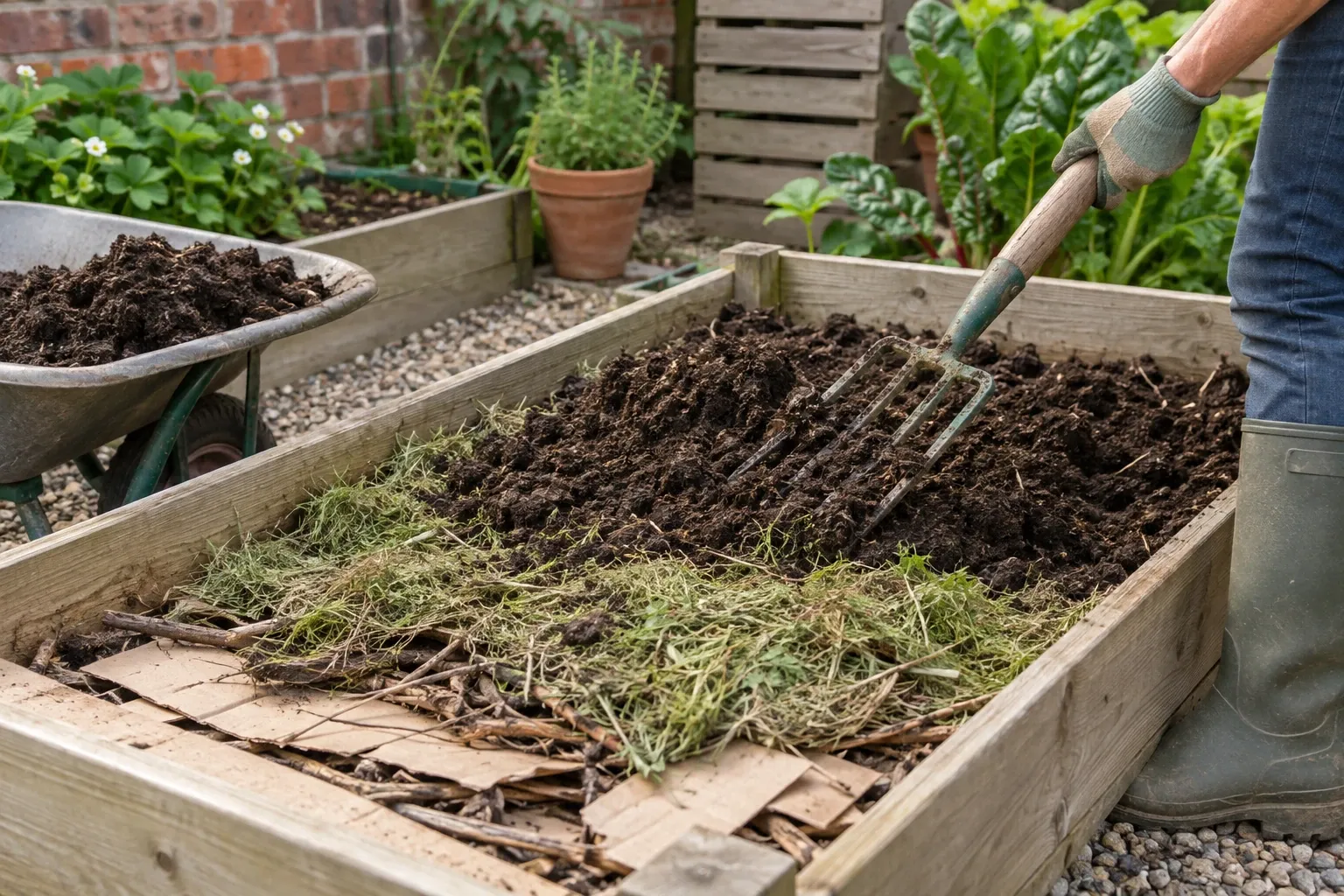
No‑dig gardening swaps spade work for a yearly layer of organic matter. It’s kinder to soil life and can cut down weeding once established. This guide shows you when cardboard helps and when it won’t, how much compost to use, and how to set out paths so you can reach every plant without treading on beds. You’ll build the bed, mulch it, and learn how to maintain it through a typical British year, with options for containers and raised beds too.
What makes no‑dig work in a small UK vegetable patch?
- You grow into a surface layer of organic matter (compost, well‑rotted manure, leafmould) added once a year; soil life mixes it in for you, which protects structure and moisture. This is the core method described by the RHS and by Garden Organic’s long‑running trials of no‑dig systems (RHS no‑dig advice; Garden Organic: the no‑dig method).
- Start in late winter if possible, provided ground isn’t waterlogged. That timing avoids winter nutrient losses and supports spring growth, per the RHS.
- Bed width around 1.2 m and paths ~45 cm make access easy without treading on soil, which limits compaction.
If you’re still choosing what to grow, start with crops you’ll use and that fit your sun and time; see how to make space in a first UK veg plot in our guide to a productive vegetable garden.
Cardboard: when it helps, when it won’t
- Use cardboard to smother grass or an area with lots of weeds; add a thick mulch on top. The RHS specifies a double layer of cardboard topped with 10–15 cm of organic matter for new beds, and says existing beds don’t need cardboard unless they’re very weedy.
- Know its limits on deep‑rooted perennials. For bindweed, the RHS recommends cardboard plus about 20 cm of organic mulch and keeping the area covered for a prolonged period, with persistent removal of any regrowth (RHS: bindweed control).
Which mulch for a no‑dig bed?
- Compost from your heap is ideal; you can also use well‑rotted manure, leafmould or peat‑free green‑waste compost. Garden Organic and the RHS list these as suitable surface mulches for no‑dig (Garden Organic: suitable materials; RHS: organic matter for mulch).
- Depth: start with 10–15 cm over cardboard or directly on existing soil; maintain with about 5 cm each year. Both figures are set out in RHS and Garden Organic guidance (RHS: 10–15 cm start, 5 cm yearly; Garden Organic: 15–20 cm start, ~5 cm ongoing).
- Direct sowing vs transplants: you can sow into the compost surface, but many growers start modules and plant out. The RHS notes that planting out module‑raised seedlings into no‑dig beds tends to suffer less slug damage because plants are sturdier.
Step‑by‑step: build the bed this weekend
- Mark out beds and paths
- Aim for beds ~1.2 m wide and paths ~45 cm wide so you can reach without stepping on beds.
- Tackle perennial weeds
- Cut top growth, then decide: if bindweed, dock or bramble are present, plan on light exclusion plus a deep mulch and ongoing checks for a season or more.
- Lay the base
- On lawn or weedy ground, overlap a double layer of plain cardboard (remove tape and staples). On clean beds, you can skip cardboard.
- Add the mulch
- Spread 10–15 cm of well‑rotted organic matter across the bed. Water the cardboard first if planting immediately.
- Plant
- Plant module‑raised veg into the mulch, or sow into a shallow surface tilth. Keep soil disturbance minimal; it’s fine to make small holes through the mulch when needed. If you’re leaning towards timber‑edged beds, see how to set up raised beds.
- Maintain
- Top up with ~5 cm of compost each year, ideally in late winter as growth resumes. Hoe or hand‑pull any weeds that appear, and keep path edges neat to stop grass creeping in (RHS: yearly mulch and edges; Garden Organic: annual top‑up).
Paths and bed care without digging
- Paths: keep them weed‑free with woodchip or membrane‑plus‑chip so you’re not tempted to tread on beds; maintain the 45 cm width for barrows and knees.
- Compaction: if ground is very firm, the RHS suggests easing it by rocking in a garden fork rather than turning the soil; raised beds help on heavy, wet soils.
How to tell it’s working
- Fewer annual weeds and easier weeding overall as buried seeds stay buried; this no‑dig benefit is highlighted by Garden Organic.
- Soil becomes darker, better‑crumbed and holds moisture longer under mulch; these are the outcomes the RHS associates with preserving soil structure and feeding it from above.
Ready to fill your new bed? Try an early crop plan and reliable starters like bush tomatoes, beetroot, salad leaves and dwarf French beans; see how to grow tomatoes from sowing to harvest if you fancy a sunny spot.