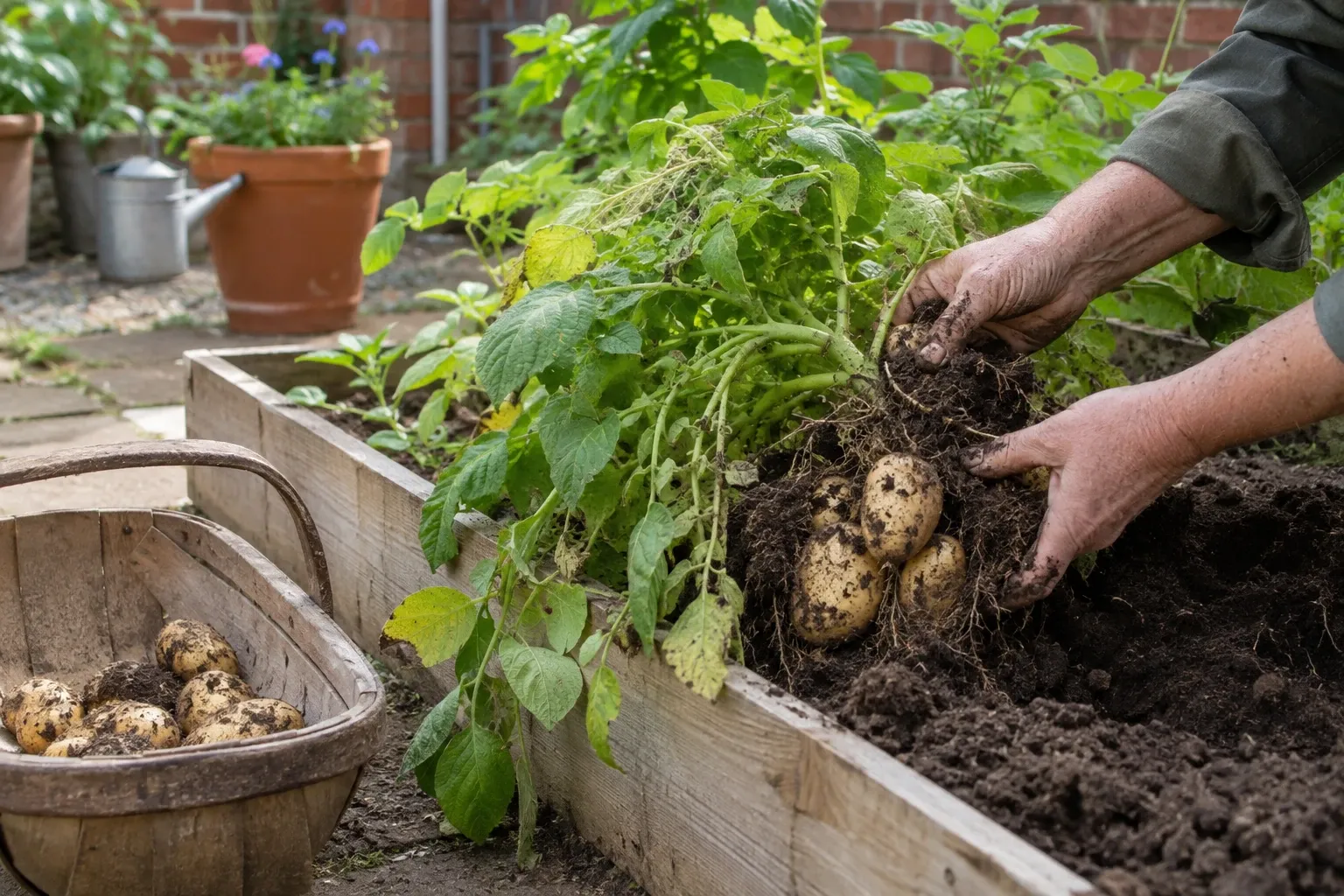
You want home‑grown spuds without turning the whole garden over. The good news is that potatoes are happy in a border, a raised bed, an allotment row or a sturdy 30 cm pot. Below you’ll find how to pick between first earlies, second earlies and maincrops, when to plant around the UK, how to protect from frost, and the essentials for containers. We also cover earthing up and the key signs to harvest, plus safety if any tubers turn green.
What do you want from your potatoes?
- Fast new potatoes for summer meals: choose first earlies (earliest) or second earlies (a little later). They grow quickly, suit small spaces and containers, and are eaten fresh. The RHS explains the early–maincrop groups and why earlies suit containers. RHS potato guide.
- Bigger spuds to store: pick maincrops. They stay in the ground longer and give larger tubers for jackets and roasting; they store for months if cured and kept cool and dark. See the same RHS guide for storage cues. RHS potato guide.
If you’re planning a productive patch alongside potatoes, start with the basics of siting, frost, and crop rotation in a first UK vegetable garden.
When can you plant in the UK, and how deep and far apart?
- Typical planting windows vary by type and region: first earlies around late March, second earlies early to mid‑April, maincrops mid‑April to early May; plant later in colder areas and earlier in milder ones. Place seed potatoes 15 cm deep. Spacing: earlies about 30 cm in rows 60 cm apart; maincrops about 37–40 cm in rows 70–75 cm apart. These timings, depths and spacings are set out by the RHS and Garden Organic. RHS timings and spacing; Garden Organic guide.
- Young shoots are frost‑tender in April and May. Earthing up (mounding soil around stems) helps shield them from late frosts and stops tubers greening. The RHS highlights frost risk and the protection earthing up provides. RHS on frost and earthing up.
Beds, raised beds or containers: which suits your space?
- Beds and rows: best for volume and maincrops. Prepare a sunny site and improve soil with compost or well‑rotted manure. Rotate yearly to reduce disease build‑up; both points are covered by the RHS. RHS soil and rotation.
- No‑dig beds: shallow‑plant then cover with a deep organic mulch; keep topping up to exclude light. Garden Organic describes no‑dig options that mirror traditional earthing up. Garden Organic on no‑dig. You can also read our take on how to start a no‑dig vegetable bed.
- Containers and patio tubs: early types are the best fit because plants are smaller and quicker to mature. Use a pot at least 30 cm wide and deep; plant one seed potato per 30 cm of pot diameter, set just below the surface, then add compost in stages as shoots grow. This container method and sizing come from the RHS. RHS container advice. If container growing will be your main approach, see ideas to make a vegetable garden out of pots.
Soil, compost and feed
- In ground: incorporate plenty of organic matter; on poorer soils you can add a general fertiliser before planting, as the RHS notes. RHS soil preparation.
- In containers: use a good peat‑free, multi‑purpose compost; keep it uniformly moist. Add compost as you earth up to shade the surface and support steady growth. Method described by the RHS. RHS on peat‑free compost and topping up.
Step‑by‑step: from planting to harvest
- Buy certified seed potatoes, not supermarket spuds, to avoid introducing viruses and diseases. Both the RHS and Garden Organic stress using certified seed. RHS on seed potatoes; Garden Organic on certified seed.
- Chit earlies if you want a head start: place tubers rose‑end up in light for 4–6 weeks until sprouts are short and sturdy. It’s optional for maincrops. Timings from the RHS and Garden Organic. RHS on chitting; Garden Organic on chitting.
- Plant at 15 cm depth. Space as above, or one seed per 30 cm‑diameter pot. Cover and water in. Depth/spacing and container rate per RHS and Garden Organic. RHS planting details; Garden Organic spacing.
- Earth up in stages as shoots reach about 15 cm, leaving roughly 5 cm of foliage showing; repeat before foliage meets across the row. This reduces greening, suppresses weeds and offers some frost and blight protection. Guidance from Garden Organic and the RHS. Garden Organic on earthing up; RHS on earthing up.
- Water consistently, especially in containers and in dry spells, to prevent checks in growth and misshapen tubers. Keep compost moist rather than saturated; the RHS recommends peat‑free compost topped up as shoots grow. RHS container care.
- Watch the calendar and the plants. As a guide: first earlies are usually ready June–July, second earlies July–August (often when flowers open or buds drop). Maincrops follow from late August to October; delay final lifting for storage until foliage yellows. Harvest cues and windows from RHS and Garden Organic. RHS harvest timings; Garden Organic harvest notes.
How do you know it’s going well?
- Foliage emerges evenly and resists late frosts thanks to timely earthing up; any blackened tips after frost should regrow from below. Frost‑tender shoots and the benefit of earthing up are noted by the RHS. RHS on frost‑tender shoots.
- Tubers are protected from light: no green skins when you lift a tester plant. If tubers have green patches, it means they’ve been exposed to light.
- Harvest aligns with type and cues above; skins of maincrops toughen after foliage dies back, which helps storage, per RHS guidance. RHS on curing and storage.
Safety note: green potatoes and sprouts
- Do not eat green, damaged or sprouting parts of potatoes; these can contain higher levels of natural toxins (glycoalkaloids). This consumer advice is set out by the NHS. NHS: starchy foods and safety.
- Greening happens in light and is linked with increased glycoalkaloids such as solanine and chaconine; store harvested potatoes in the dark to prevent it. Industry guidance from AHDB explains this link. AHDB on greening and toxins.
If you’re mapping out space for spuds alongside other crops, use our overview to plan a first UK vegetable garden before you commit rows or containers.