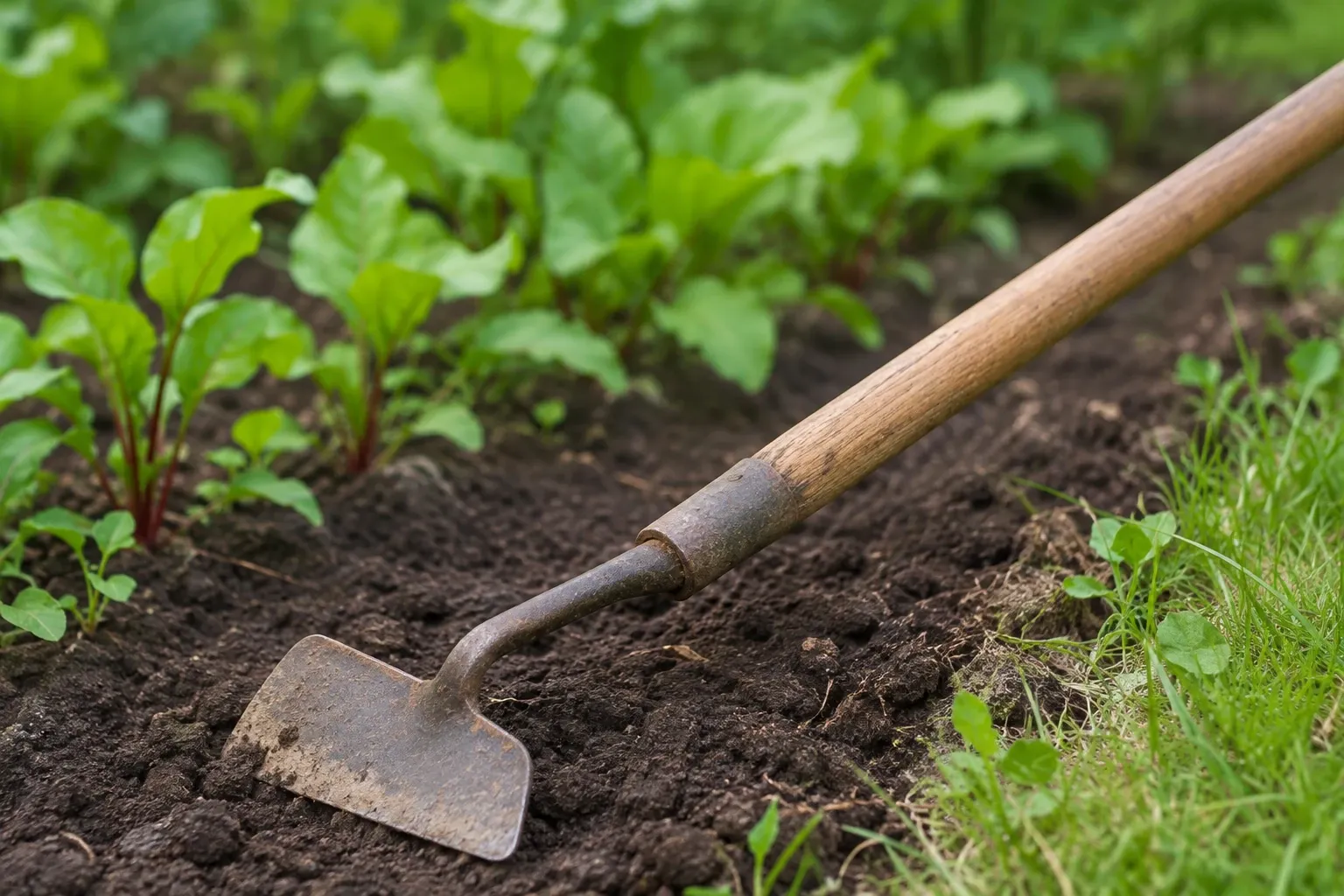
A hoe is most useful when weeds are small and you can work across the soil without catching crop stems or roots. But “garden hoe” covers tools with different blades and actions: a broad, long-handled hoe is not the same choice as a compact hand hoe for a raised bed or a draw hoe for breaking ground. Your layout, posture and main task matter more than owning several styles.
What do you want your hoe to do?
Start with the job, not the name on a product label. A hoe is principally useful for removing small weeds from open soil, but some designs are better suited to shallow slicing, chopping, working between rows or loosening a compacted surface. It is not a substitute for a fork when you need to lift a deep-rooted weed, nor for a rake when you need to gather loose debris.
If you are equipping a new plot, think about the hoe alongside the other basics you actually use. The broader set of tasks and tools for a first garden is covered in a practical starter tool set, while getting a garden started and cared for in the UK involves more than weed control alone.
Which hoe style suits your beds?
| Hoe style | Useful for | What to bear in mind |
|---|---|---|
| Dutch hoe | Skimming a blade through open beds and between rows to sever small weeds | Its broad head needs room to move; take care near crops and established roots |
| Stirrup or loop hoe | Back-and-forth surface work, especially where you want to cut on both strokes | The loop can snag on clumps or plants if the bed is crowded |
| Draw hoe | Pulling a blade towards you to chop, shape soil or open a shallow drill | The chopping action is less suited to close work around delicate plants |
| Hand hoe | Small beds, containers and narrow gaps where a long head will not fit | You work close to the ground, so consider bending, kneeling and reach |
These are useful distinctions, not a rule that every garden needs all four. BBC Gardeners’ World describes the Dutch, draw, stirrup and heart-shaped styles, and notes how their blade shapes support different actions. For a small plot with mostly open vegetable rows, one comfortable long-handled hoe may do more useful work than a collection of specialist heads. If you garden mainly in containers or densely planted beds, a hand hoe may be easier to control.
A heart-shaped or pointed head can help with furrows or breaking a hard surface, but that does not make it the best tool for every weeding job. Match the head to the work you repeat. For scattered weeds around established perennials, a hand fork or careful hand-pulling may be more appropriate than sweeping a blade across the bed.
What should you check before choosing?
Start with reach and posture. A long handle should let you work upright rather than lean far forward; if it is too long or the head is difficult to steer, it can be awkward in a narrow bed. Try to assess the grip, balance and weight as well as the shaft length. A handle that feels comfortable in the hand and a head you can guide without straining matter more than a feature list.
Then consider the width and shape of the blade. A wider blade can cover open ground efficiently, but a narrower head may be easier to guide between close rows or around plants. The blade angle affects whether the tool skims the surface or digs in. If you can, hold the hoe as you would use it and check that the head sits at a workable angle for a light, shallow stroke.
Material is a practical consideration, not a guarantee of performance. Steel heads differ in weight and finish; handles may be wooden or metal. Look for a secure connection between head and shaft, a grip that does not feel slippery, and a blade you can keep clean. If you already own tools with interchangeable handles, check compatibility before buying a head; not every attachment fits every system.
How do you use a hoe without damaging crops?
- Identify the plants first. Decide which seedlings are crops or wanted self-seeders and which are weeds. Marking crop rows can help you keep the hoe in the clear spaces.
- Choose a dry spell for routine hoeing. In its advice on weeding beds, the Royal Horticultural Society recommends hoeing annual and short-lived weeds in dry conditions and moving the blade just beneath the surface. The aim is to sever the weed, not to turn over a deep layer of soil.
- Use light, controlled strokes. Work between rows and in open patches, keeping the blade away from crop stems. Avoid chopping or scraping deeply: Minnesota Extension notes that deep hoeing can harm vegetable roots. Its advice comes from a different climate, but this basic caution about root damage applies when working around plants.
- Deal with larger or persistent weeds separately. A hoe may cut the top of a weed without removing its roots. The RHS advises lifting many perennial weeds carefully, because pieces of root can regrow. Use a fork or hand removal where appropriate rather than chopping a spreading root system into fragments.
- Check what you have cut. In dry conditions, small weeds may shrivel; pick up larger pieces, especially if the soil is damp and they could re-root. Keep troublesome perennial roots out of ordinary home compost unless you know they have been treated appropriately.
Use a hand hoe or your fingers for close work around plants instead of swinging a long-handled head through their root zone. A hoe’s reach is useful in open rows, but it also makes it easy to strike a plant you cannot see beneath foliage. Slow down where crop leaves overlap or where labels and irrigation lines cross the bed.
When is a hoe the wrong tool?
A hoe works best against small weeds that can be cut near the surface. Large weeds, deep taproots and plants with creeping roots need a different approach. Pulling or lifting carefully is often a better option, especially when a weed is growing through an ornamental plant or close to a crop. The RHS also points out that some perennial weeds can return from root sections, so simply slicing through them may not solve the problem.
Do not use the hoe as a general-purpose digging tool unless its design suits that task. A light Dutch hoe intended to skim soil is not made for prising out stones or cutting through thick roots. For hard ground, first consider whether the soil is too dry to work comfortably; for a compacted patch or a new bed, a suitable digging tool may be more effective.
Hoeing will not keep a bed permanently weed-free. New seeds can arrive and germinate, and weeds can spread in from surrounding areas. The University of Minnesota Extension describes how weeds may enter from lawns and other neighbouring ground, including in raised beds and containers. In a UK garden the timing and species will differ, but the practical point remains: inspect the bed regularly and deal with seedlings before they become established.
How can you tell if your choice is working?
After using the hoe, look for cut seedlings lying loose at the surface and check that crop stems remain untouched. If the head keeps catching on plants, stones or clods, change your stroke, work by hand in that section or choose a narrower tool. If you are bending or leaning throughout, the handle may not suit your height or working area. Comfort is part of whether a tool is genuinely useful.
Notice whether weeds are actually weakening. A surface pass may clear annual seedlings, but shoots returning from the same established root suggest you need to identify the weed and remove it differently. If the soil is wet and severed weeds stay alive, wait for drier conditions before repeating the pass. For broad, open beds, a long-handled hoe can make regular maintenance convenient; for a cramped patio or mixed border, careful hand work can be more precise.
Clean soil from the blade after use and store the hoe dry. A clean head is easier to inspect for damage, and a sound handle and firm head-to-shaft joint make the tool safer to control. The best choice is the one that fits the space, lets you work comfortably and suits the weeds you are actually dealing with, not the one with the most elaborate design.