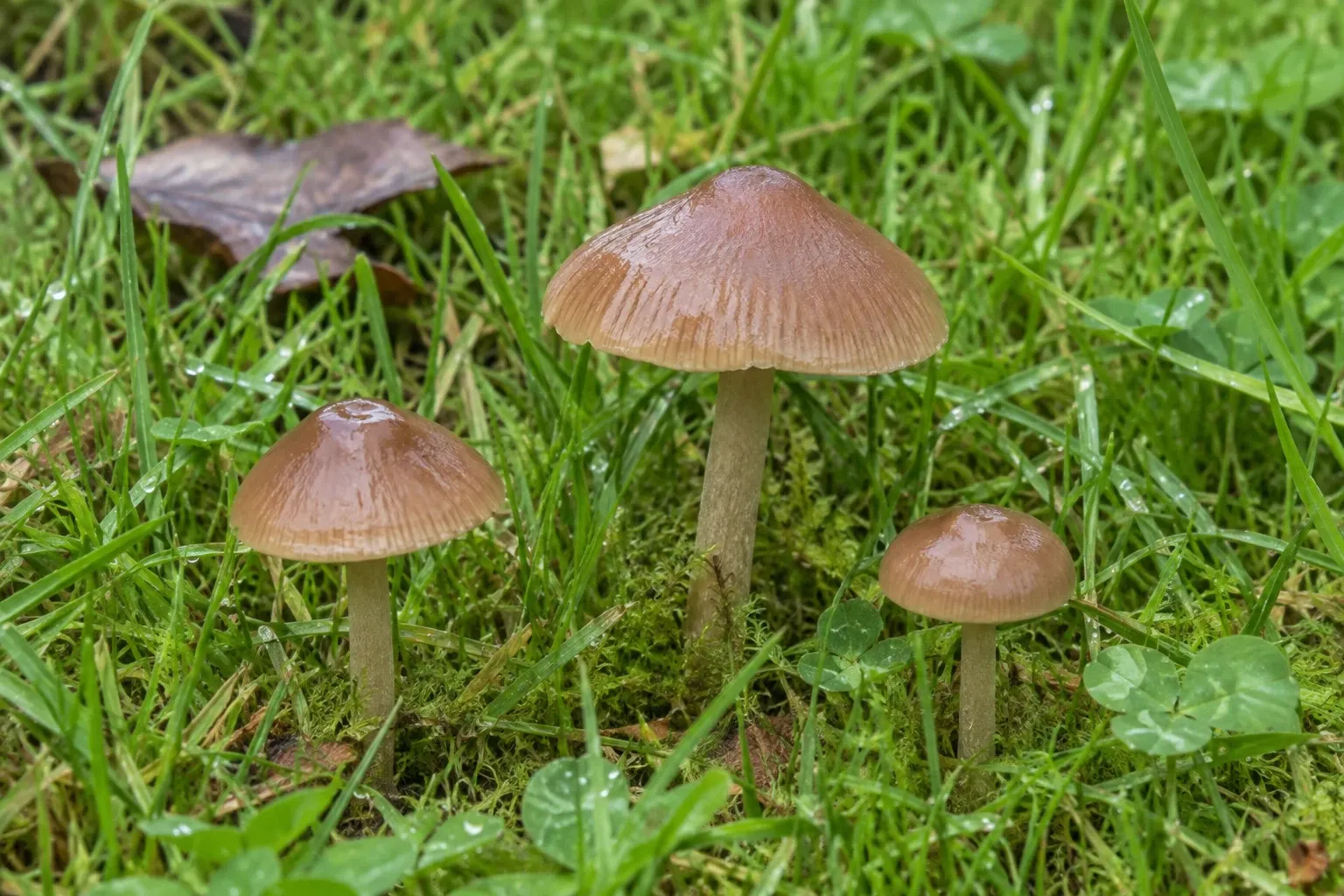
You may notice mushrooms scattered through the grass, clustered over buried wood, or appearing in a circle beside a brown or unusually green patch. The mushrooms are the visible fruiting bodies of fungi, much of whose growth remains beneath the turf; their appearance alone does not show whether the grass is in trouble or what species is present. Look at the pattern and condition of the lawn before deciding whether to leave them, remove them for practical reasons, or investigate damaged turf.
Are mushrooms in a lawn a sign of a problem?
Often, no. Fungi feed on or interact with material beneath the turf, and the mushrooms you see are their short-lived fruiting bodies. Many fungi in gardens do not harm plants; some break down dead organic matter and help return nutrients to the soil. The RHS notes that toadstools and fairy rings commonly appear in lawns in autumn, while the timing can vary by fungus. A flush of mushrooms by itself is not a reason to treat or replace the lawn. See the RHS explanation of toadstools in gardens for the distinction between visible fruiting bodies and the fungus growing below ground.
First check what is happening to the grass. If it is green and growing normally, and mushrooms are simply scattered across it, you can usually leave the area alone. If you are already assessing soil, light and routine care across your plot, the wider advice on starting and caring for a UK garden can help put the lawn in context.
What does a ring or brown patch tell you?
A roughly circular pattern of mushrooms can be part of a fairy ring: a fungal colony that spreads through the soil beneath the grass. Some fairy rings have little visible effect on turf. Others can leave a ring or part-ring of dead grass, sometimes bordered by greener growth. The RHS describes the most damaging fairy-ring fungus as spreading gradually through the root zone; its growth may make soil water-repellent, leaving grass short of water in dry weather even when the fungus is not directly attacking the roots.
Look for a pattern over time rather than diagnosing from one visit. Note where mushrooms appear and whether the same area develops brown, bare or greener grass. A photo from the same viewpoint can make changes easier to spot. Mushrooms in a line or cluster may also be growing from buried dead roots or other organic material, so a circle is a clue, not a definitive identification. If a tree or shrub nearby is declining, or mushrooms cluster at its base, investigate that plant separately; fungi associated with woody plants are a different concern from an ordinary flush in the lawn.
Fairy rings can be slow-moving. The RHS says some colonies expand by about 30 cm a year and can persist for many years. That does not mean every ring will damage the grass or need removal. It does mean that a ring that gradually changes position is more informative than a single crop of mushrooms.
Should you remove the mushrooms or leave them?
Choose according to access and the condition of the lawn. If the mushrooms are out of reach and the turf looks healthy, leaving them is a reasonable option. If small children or pets use the lawn, you may prefer to remove visible mushrooms promptly and keep them out of reach. Wear gloves, avoid letting anyone taste them, and wash your hands afterwards. Appearance alone is not a safe way to decide whether a wild mushroom is edible: the RHS cautions that identification can be difficult without dedicated study. Do not eat lawn fungi.
Removing the visible mushrooms is a practical precaution, not a way to eliminate the fungus. The RHS explains that spores can travel long distances, so picking mushrooms will not stop spores arriving or remove the underground colony. For the same reason, mowing over a flush is not a dependable control method. If you mow, pick up visible mushrooms first where children or animals might access them, and follow ordinary mower safety practices.
If you need to clear leaves or loose debris as part of routine lawn care, choose a tool for the surface rather than scraping into the turf; a rake suited to lawn work can help with that separate task. Avoid aggressive digging just to chase mushrooms: the visible fruiting bodies do not show the full extent of the fungus underground.
What can you do about damaged grass?
Where a ring has killed or weakened grass, focus on the turf rather than trying to eradicate every mushroom. Keep notes on whether the area is dry, whether water runs off or fails to soak in, and whether the damaged section grows. The RHS recommends spiking and watering affected patches to help break up water-repellent conditions, with feeding where dead grass has left a patch. Make changes carefully and assess the result; broad, heavy feeding is not a substitute for identifying why the turf is struggling.
For severe fairy-ring damage, removing the active fungal front is possible in principle, but the RHS says this would mean taking out turf and soil to at least 30 cm deep, replacing the soil and returfing or reseeding. It describes that approach as usually impractical, particularly for large rings. Weigh the amount of damaged lawn against the disruption before considering it. For a small patch, tending the grass and monitoring it may be more proportionate than excavating a large area.
There is no need to apply a lawn fungicide for ordinary mushrooms. The RHS states that no fungicides are available to gardeners for fairy-ring control. Avoid using chemical treatments unless a qualified source has identified a specific lawn disease and a suitable, lawful product; mushrooms alone are not a diagnosis.
How can you check whether your response is working?
Revisit the same spots after the next flush and through the growing season. Record whether the grass is recovering, whether a brown ring is widening, and whether the mushrooms return in the same locations. A disappearing flush with healthy turf calls for no further intervention. A persistent or expanding patch deserves attention to water penetration and grass recovery, rather than repeated picking alone.
If the lawn is accessible to children or pets, keep monitoring for new mushrooms and remove those within reach. If someone may have eaten one, treat it as a possible poisoning rather than waiting to identify it from appearance: the NHS advises urgent medical help when a person may have swallowed something harmful. If the grass continues to die or nearby woody plants are also failing, seek advice from a suitable gardening or plant-health source and provide clear photos of the whole affected area.