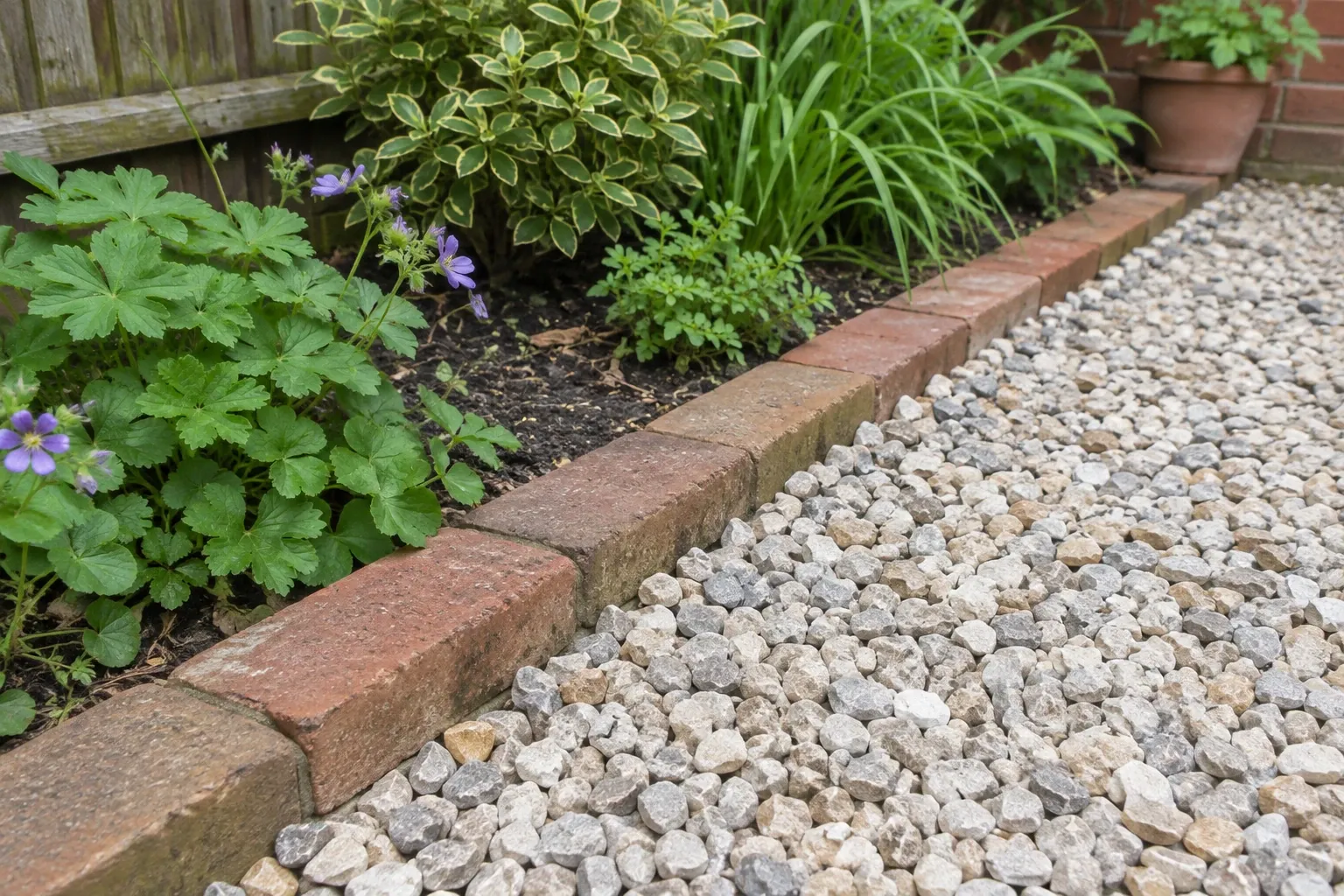
If you are choosing gravel for a small garden, start with the job it needs to do. Stone that looks attractive around plants may shift underfoot on a path, while a surface that works for walking is not automatically a suitable base for cars. Consider the route, planting, soil and rainwater together; that will help you choose a useful grade and avoid making a feature that is awkward to weed or keep level.
What do you want the gravel to do?
Draw the area on a simple plan and mark where people walk, where plants will grow and whether a vehicle will use it. A path needs a firm, comfortable surface; gravel used as a border mulch should leave room for plants and water to reach the soil; a drive has to cope with repeated weight and manage runoff. These are different jobs, even if you use a similar-looking stone. For the wider layout, including routes and planting space, plan a practical garden layout.
In a front garden, think about the walk from the pavement to the door as well as any parking space. A clear paved or otherwise stable route can sit beside planted areas finished with gravel, rather than making the whole entrance one undifferentiated surface. If you are weighing up ways to organise that space, make the front entrance work.
Gravel is loose aggregate: small stones that are spread over a prepared surface. The size, shape and material affect how it feels underfoot, how easily it moves and how it looks beside paving, brick or plants. It is not the same as a compacted sub-base, the structural layer beneath a finished surface.
Which gravel suits paths, borders and vehicle access?
For a path, prioritise a stable walking surface over colour alone. The Royal Horticultural Society (RHS) describes fine gravel as 10mm or less, chunkier gravel as 20mm or more, and notes that medium-grade, angular gravel is easier to walk on than small rounded pea shingle or large cobbles. Take a handful of samples if you can: a stone that looks good in a bag may feel loose underfoot once spread. Check the supplier’s stated size range as well as the sample, because the grade affects the finished texture.
For a planted bed, gravel is a mineral mulch: a surface covering that can help suppress weeds and reduce water loss. The RHS says gravel and other decorative aggregates are used as mulch, and gives a general mulch thickness of at least 5cm. That is a useful reference for coverage, not a promise that gravel alone will prevent weeds. Fine material can work into the soil over time, and weeds may establish in accumulated debris or grow through gaps. The RHS also notes that gravel can mix with the underlying soil if it is not applied thickly enough.
For a driveway, distinguish the decorative top layer from the construction below it. Loose gravel is not a substitute for a properly prepared base designed for vehicle loading. The UK government’s guidance on permeable front-garden surfacing describes gravel as one possible permeable surface, while stressing that a suitable design depends on factors such as the slope, soil and whether the site gets waterlogged. If vehicles will use the area, investigate the full build-up and drainage rather than choosing a surface stone in isolation. Do not assume that loose gravel will stay put on a steep approach or where tyres repeatedly turn.
How should colour, stone type and planting affect your choice?
Choose a colour that works with existing hard surfaces and the plants you want to grow. The RHS suggests matching gravel to other stone or paving in the garden and notes that local gravels are usually the cheapest option. Treat that as a practical comparison, not a fixed price guarantee: availability and delivery depend on where you live and what the supplier stocks. A small sample viewed in both sun and shade can help you judge whether its tone will sit comfortably beside brickwork or paving.
Planting conditions matter more than a Mediterranean look alone. The RHS says a sunny, well-drained position suits many Mediterranean plants, while heavy clay, damp ground or a high water table may not suit gravel-garden plants. If your soil stays wet, first consider whether the plants and surface are suitable for those conditions instead of assuming a layer of stones will solve the drainage problem. For acid-loving plants, avoid limestone chippings, as the RHS specifically cautions against using them in that setting.
Decide whether you want plants to self-seed between stones. If you do, leaving the soil accessible may fit the style better; if you prefer a more controlled layout, consider how a permeable landscape fabric would affect planting and future changes. The RHS describes fabric as one approach for reducing weeds, but also notes that gravel gardens can be managed without it, with self-seeded plants and extra weeding as possible trade-offs. Keep small plants visible: gravel can swamp them, so a slight mound around the rootball may help keep the crown above the surrounding surface.
How do you prepare and lay the gravel?
First remove existing weeds and decide where the gravel should stop. Edging can keep loose stones from spreading into a lawn, paving or neighbouring planting; choose an edge that suits the material and upkeep you can manage. If the area meets a lawn, consider whether a mower can pass safely without scattering stones. For more on that boundary, see choose suitable garden edging.
For a path or planted bed, prepare an even surface and plan how you will reach plants for weeding and watering. If you use a fabric layer, make sure it is permeable so rain and irrigation can pass through. The RHS cautions that a waterproof layer can cause runoff and drainage problems elsewhere. In a planted bed, leave openings large enough for plants to establish rather than cutting tiny slits that may constrict their roots.
Estimate the quantity before ordering. The RHS says a 25kg bag covers 0.6 square metres at a 5cm depth. It also says bulk gravel is often delivered in bags holding about 1 cubic metre, which should cover around 20 square metres. These are coverage estimates from the RHS, so check the supplier’s product and allow for the actual area and required depth. Measure the length and width, multiply them to find the area, and use the stated coverage to estimate how many bags you need. For an irregular shape, split it into simpler rectangles and add their areas.
Spread the gravel evenly rather than making deep heaps around stems or path edges. For planting, leave the crown—the point where stems meet roots—clear of excess stones. For vehicle access, get construction advice specific to your ground, vehicle use and drainage requirements before excavation; a decorative gravel depth alone does not establish that the drive will be structurally suitable.
How can you check whether the result is working?
After the first rain, look for water that runs towards the house, collects in low spots or escapes onto a path. The government guidance notes that soil type, slope and existing waterlogging affect which permeable approach is appropriate. Gravel on the surface does not, by itself, prove that the whole drive drains acceptably. If water ponds or flows where it should not, reassess the levels and drainage before adding more stone.
Walk the path in ordinary shoes and check whether the surface shifts, feels unstable or spills over its edges. Rake displaced stones back into place and top up where the underlying layer becomes exposed. In a planted gravel area, look for weeds during establishment and remove them before they seed; the RHS says weeding is most intensive in the first few years, after which established plants can help suppress weeds. Check that gravel has not buried small plants or crept against stems.
Finally, decide whether the maintenance matches your expectations. Gravel may need occasional levelling, topping up and hand weeding, and leaves or other debris can collect among the stones. If that upkeep feels unsuitable, use gravel only where its appearance or drainage role is useful, and choose a different finish for the rest of the garden.